
Convert salary to hourly pay
From TaskSprig · How results work
To compare gross pay, first decide how many hours and weeks are paid. Gross means before deductions. The examples below use one display currency, 40 paid hours per week, five paid workdays and 52 paid weeks per year; they do not calculate taxes or currency exchange.
1. Annual salary to hourly pay
Hourly equivalent = actual annual compensation ÷ (paid hours per week × paid weeks per year).
Enter 52000 as Gross amount and choose Annual. Keep Actual annual compensation, 40 paid hours, five days and 52 paid weeks. The result is 52,000 ÷ 2,080 = 25.00 per paid hour.
2. Monthly salary to hourly pay
Enter 5200 and select Monthly (12/year). At 52 paid weeks, annual compensation is 5,200 × 12 = 62,400; the hourly equivalent is 62,400 ÷ 2,080 = 30.00. Monthly input represents a recurring full-year rate and is prorated if you choose fewer paid weeks.
| Starting amount | Annual compensation | Hourly equivalent |
|---|---|---|
| 52,000 annually | 52,000.00 | 25.00 |
| 5,200 monthly | 62,400.00 | 30.00 |
| 25 hourly | 52,000.00 | 25.00 |
3. Hourly rate to annual compensation
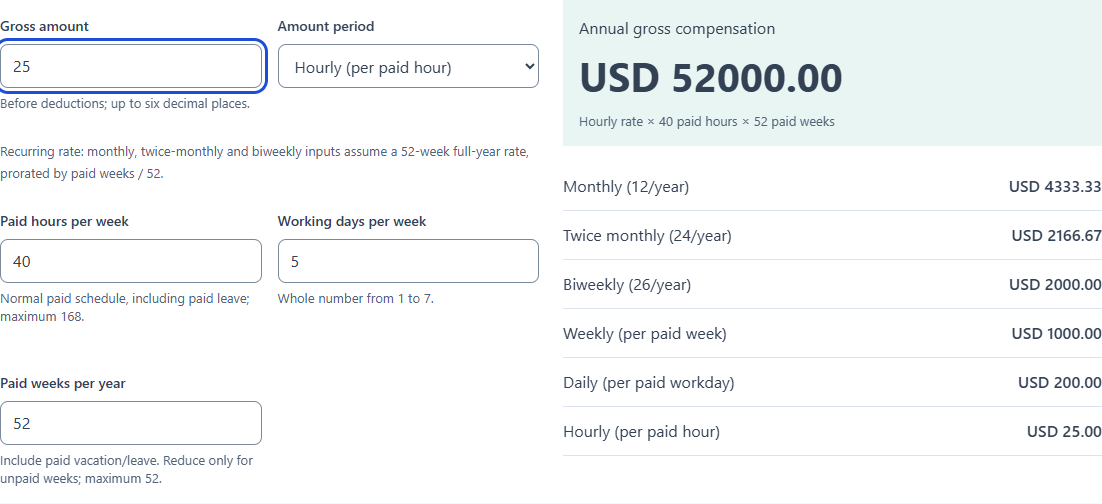
Choose Hourly and enter 25. The main result answers the reverse question: 25 × 40 × 52 = 52,000.00 annually. The equivalents table retains the other periods. No overtime premium is added by this conversion.
4. Distinguish paid weeks from actual work
Paid leave stays within paid weeks. If you receive 52,000 in total even though only 48 weeks are paid, Actual annual compensation keeps that total: 52,000 ÷ (40 × 48) = 27.08 per paid hour.
If 52,000 instead describes a full-year salary rate and four weeks are unpaid, choose Full-year salary rate. Annual compensation becomes 52,000 × 48 ÷ 52 = 48,000, giving 25.00 per paid hour. Choose the basis that matches your actual arrangement; the calculator cannot decide it for you.
To inspect extra working hours, expand Effective rate from actual work. For annual compensation of 52,000 and 45 actual hours over 52 worked weeks, the effective rate is 52,000 ÷ 2,340 = 22.22 per worked hour. This comparison does not calculate overtime entitlements.
5. Compare and keep the assumptions
Enable Compare two scenarios for another amount or schedule in the same currency. Biweekly conventionally uses 26 payments per year; twice monthly uses 24. Actual dated payroll calendars can differ.
Copy the comparison or download CSV/PDF with its assumptions. For recorded hours, open Use recorded timesheet hours and import a completed version-2 timesheet JSON, or transfer it from the timesheet tool. Review the dates and explicitly acknowledge any projection before applying the average. The original timesheet rate stays unchanged.
Results use exact decimal fractions with rounding for display. Changing currency changes labels and decimal precision, not exchange rates. These are gross comparisons without tax, deductions, benefits or statutory payroll rules. Nothing is automatically saved.
Next: calculate recorded hours with breaks, or open the timesheet calculator.